Ireland360
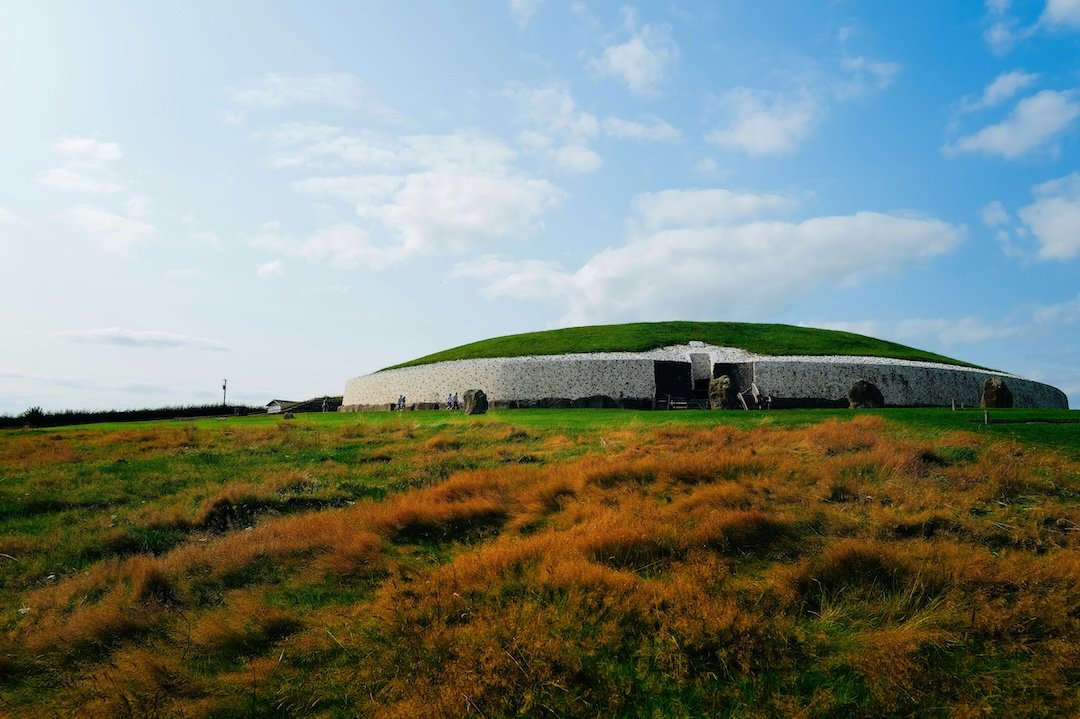
If you only see one ancient site in Ireland, make it Newgrange in the Boyne Valley: a 5,000-year-old passage tomb that’s older than Stonehenge and the pyramids at Giza. Pair it with the Hill of Tara nearby and you’ll have covered the two most famous places in Irish prehistory in a single day. Beyond them, the west and north are full of stone forts, megalithic cemeteries and early monasteries that see a fraction of the visitors.
The Boyne Valley and County Meath
Newgrange, Knowth and Dowth
The Brú na Bóinne complex, a UNESCO World Heritage Site, contains three great passage tombs and dozens of smaller monuments. Newgrange is the star: a huge circular mound with a decorated entrance stone and a long passage leading to a cross-shaped chamber. Around the winter solstice, the rising sun shines through a roof-box above the entrance and lights up the chamber floor. Places inside for the solstice sunrise are given out by lottery, but the visitor centre recreates the effect for everyone else.
Knowth has more megalithic art than anywhere else in Western Europe, while Dowth is visible from the road but not open inside.
All visits to Newgrange and Knowth start at the Brú na Bóinne Visitor Centre, with shuttle buses to the tombs. If you’re coming from Dublin, a Newgrange and Boyne Valley tour takes care of transport and timing. For the full story of the tomb itself, read our guide to Newgrange.
The Hill of Tara
The Hill of Tara was the ceremonial seat of the High Kings of Ireland. What you see today is a grassy hilltop of earthworks rather than buildings, but the Mound of the Hostages (a Neolithic passage tomb) and the Lia Fáil, the standing stone said to roar when the rightful king touched it, give a sense of how important this place once was. On a clear day the views reach across much of the midlands.
Skryne, just across the valley, is a tiny village with a ruined church on its own hilltop and O’Connell’s, an old-fashioned country pub for a drink afterwards.
Loughcrew
An hour west, the Loughcrew cairns sit on hilltops above the Meath countryside. It’s a short, steep climb to the main cairn on Carnbane East, where the inner stones are carved with suns, flowers and spirals. Around the spring and autumn equinoxes, the rising sun lights up the back stone of the chamber. It’s quieter than Newgrange, and many locals prefer it.
Monasterboice and Mellifont
Just north in County Louth, Monasterboice has a round tower and two of the finest high crosses in Ireland, carved with scenes from the Bible. Nearby, Old Mellifont Abbey was the first Cistercian monastery in the country. Both make an easy add-on to a Boyne Valley day.
The west: forts and megalithic cemeteries
Carrowmore and Knocknarea, County Sligo
Carrowmore is one of the largest megalithic cemeteries in Ireland, with dozens of tombs and stone circles in fields just outside Sligo town. Above it rises Knocknarea, topped by a huge unopened cairn known as Queen Medb’s Tomb. The climb takes about an hour round trip and you can see across Sligo Bay from the top.
Céide Fields, County Mayo
On the north Mayo coast, the Céide Fields are the remains of a Stone Age farming landscape, with field walls preserved under the bog for thousands of years. The visitor centre explains how it was found, and the centre stands on cliffs above the Atlantic.
Dún Aonghasa, Inis Mór
On the largest of the Aran Islands, Dún Aonghasa is a semicircle of drystone walls on the edge of a sheer cliff, with a band of sharp standing stones (a chevaux-de-frise) defending the approach. Ferries leave from Rossaveal and Doolin, and some trips, like the Aran Islands and Cliffs of Moher tour, combine the island with a cruise under the cliffs.
Rathcroghan, County Roscommon
Rathcroghan is the ancient royal site of Connacht and the legendary home of Queen Medb. The landscape is scattered with mounds and ring forts, and Oweynagat, the “Cave of the Cats”, was long believed to be a gateway to the Otherworld, closely tied to the festival of Samhain. Start at the Rathcroghan Visitor Centre, which runs guided tours of the sites.
Early Christian Ireland
Skellig Michael
About 12 kilometres off the Kerry coast, Skellig Michael is a rock pinnacle where monks built beehive huts and terraces more than a thousand years ago. It’s a UNESCO World Heritage Site and landing is tightly controlled, with a limited number of boats permitted each day in season. A Skellig landing cruise is the way to get on to the island; there are over 600 steep, uneven stone steps to the top.
Clonmacnoise and Glendalough
Clonmacnoise, on the Shannon in County Offaly, and Glendalough in Wicklow are the two great monastic cities of early medieval Ireland. Both have round towers, high crosses and ruined churches, and both are easy to reach by car.
Gallarus Oratory, Dingle
The Gallarus Oratory on the Dingle Peninsula is a small, boat-shaped church built of drystone with no mortar, and it has kept out the Atlantic weather for centuries.
Putting a route together
The Boyne Valley makes the easiest day: Newgrange in the morning, the Hill of Tara after lunch and Monasterboice on the way back north or east. Loughcrew is a better fit if you’re heading west towards Sligo or Fermanagh, since it’s off the main Dublin routes.
In the north-west, a day around Sligo town covers Carrowmore, the climb up Knocknarea and Creevykeel court tomb near the Donegal road. The Burren in Clare, with the Poulnabrone portal tomb close to the main road, fits easily into a Cliffs of Moher day. If you’re spending time in Kerry, the Dingle Peninsula has early Christian sites at almost every bend of the Slea Head Drive, from Gallarus to the beehive huts near Fahan.
Good to know
- Book Brú na Bóinne early. Tickets for the tombs are limited and sell out, especially in summer. You can’t drive directly to Newgrange.
- Wear proper footwear. Loughcrew, Knocknarea and Dún Aonghasa all involve uneven, sometimes slippery ground.
- Respect the sites. Don’t climb on walls or tombs, and don’t take stones from cairns. Many are on private farmland, so close gates behind you.
- Some sites are seasonal. Visitor centres in the west may close or reduce hours in winter, and Skellig landings only run in the summer season, weather permitting. Check before you travel.
- Join a guided visit if you can. A guide can explain carvings, alignments and legends you’d otherwise walk past.
FAQ
How old is Newgrange?
Newgrange was built around 3200 BC, which makes it older than both Stonehenge and the Great Pyramid of Giza.
Can you go inside Newgrange?
Yes, on a guided tour from the Brú na Bóinne Visitor Centre. You walk down the passage into the chamber, where the guide explains the solstice alignment.
What is a passage tomb?
A passage tomb is a stone chamber reached by a long, narrow passage and covered by a mound of earth or stones. Most in Ireland date from the Neolithic period. Newgrange, Knowth, Loughcrew and Carrowmore all belong to this tradition, and many are aligned with sunrise or sunset on particular days of the year.
Is the Hill of Tara worth visiting?
If you enjoy history and landscape, yes. There’s little to “see” in the way of buildings, but the earthworks, the standing stone and the views make it memorable, and it’s an easy stop on the way to or from Newgrange.
What’s the best ancient site in the west of Ireland?
For sheer drama, Dún Aonghasa on Inis Mór. For atmosphere and fewer people, Carrowmore and Knocknarea in Sligo.